Diced / granulated
Produced by cutting/crushing kernels into smaller pieces for inclusions and mixes. Common bands: 0–4, 1–3, 2–4, 3–5, 4–8, 5–11 mm, and custom ranges up to 0–12 mm.
Controlled-cut Turkish hazelnuts built for repeatable dosing, inclusions and coatings — with defined size bands, fines control options and export-ready packaging aligned to your QA plan.
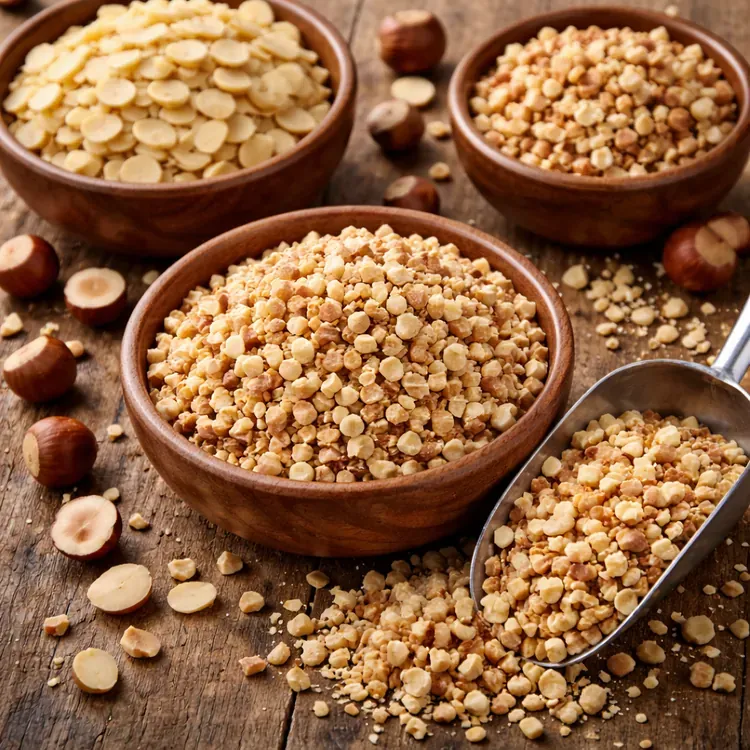
Controlled cuts are used when your process needs repeatable flow and uniform distribution: inclusion dosing in bars and biscuits, coating/enrobing lines, cereal blending, ice-cream inclusions and dairy toppers. We align the cut type, size band and fines limit to your equipment and your finished product requirements.
If you already run sieve specs internally (e.g., “2–4 mm with max 10% under/over”), send them and we’ll map to a stable product definition.
Choose the variant that fits your flavor, color and shelf-life goals.
| Variant | What it means | When to use |
|---|---|---|
| Natural (with skin) | Kernel pieces with brown skin; natural nut contrast. | Bakery, cereal, cookies, inclusions where brown skin is acceptable / desired. |
| Blanched (skin removed) | Lighter color pieces; cleaner visual and smoother mouthfeel. | Light-colored fillings, premium bakery, white chocolate inclusions, clean color targets. |
| Roasted | Roast-driven aroma and crunch; moisture targets optimized for stability. | Flavor-forward inclusions, toppings, coated nuts, chocolate and snack mixes. |
Processed hazelnut products are commonly supplied to Turkish standards (e.g., TS 1917) or customer specifications, with lot-based documentation support. (Standards and certificates can be aligned to destination-market requirements on request.)
We can supply standard industrial size bands and build tolerance windows around your application. Below are common reference bands used in industrial catalogs and specification sheets.
Produced by cutting/crushing kernels into smaller pieces for inclusions and mixes. Common bands: 0–4, 1–3, 2–4, 3–5, 4–8, 5–11 mm, and custom ranges up to 0–12 mm.
Irregular chopped pieces used as inclusions and toppings, supplied roasted or blanched. Moisture targets differ by variant, supporting shelf-life and texture goals.
Thin lengthwise slices designed for bakery and cereal decoration. Common thickness bands: 0.7–1.0, 0.8–1.2, 1.0–1.2, 1.0–1.5 mm.
For diced/chopped formats, we define: (1) nominal band (e.g., 2–4 mm), (2) allowable under/over fraction, and (3) fines limit (dust). This reduces dosing drift and improves repeatability across production lots.
Your final COA values are issued per lot. Below is a practical baseline used in industrial diced specifications.
| Parameter | Typical baseline / options |
|---|---|
| Ingredient | 100% hazelnut |
| Calibration | Commonly supplied across 1–12 mm bands; size differences (e.g., 2/3/4 mm steps) set by product definition |
| Moisture | Roasted diced: max 3%; Blanched diced: 3–5% (targets can be aligned by variant and shelf-life needs) |
| Fat content | Typical range 55–68% (variety-dependent) |
| FFA | Max 1% |
| Peroxide value | Max 1.0 meq/kg |
| Aflatoxin B1 | Max 5 ppb |
| Total aflatoxin | Max 10 ppb |
| Foreign matter | Max 0.05% |
| Under/Over calibre | ±10% max (example window; align to your dosing tolerance) |
| Dust / fines | Defined by application (lower fines for coating and hopper-fed dosing) |
| Sensory | Uniform appearance; typical hazelnut taste/odour; crisp texture; roast color aligned to requested degree |
Typical limits used in diced hazelnut specs include: Total Plate Count 2000/g max; Salmonella absent/25g; E. coli <10 cfu/g; Yeast & mould 100 cfu/g max; Enterobacteriaceae 100 cfu/g max; Coliform 10 cfu/g max.
Contains: hazelnut. Cross-contact controls and factory allergen matrix can be provided on request (aligned to your label and destination-market rules).
To reduce downtime and product variation, match the cut format to your processing step:
If you share your equipment type (auger vs cup filler, belt spreader, tumble coater) we’ll recommend a size band and fines window.
Common industrial usage patterns and process notes from our applications library:
Select packaging based on oxidation sensitivity, handling, and freight mode (sea/road). We align packaging to your warehouse and QA workflow.
| Packaging format | Typical sizes | Best for |
|---|---|---|
| Polylined cartons | 10 / 12.5 / 20 kg | Clean handling, controlled humidity exposure, fast receiving and sampling. |
| Vacuum bags (with/without carton) | 0.5 / 1 / 2 / 5 / 10 / 12.5 / 15 / 20 / 25 kg | Roasted pieces and sensitive cuts where oxygen control protects aroma and shelf-life. |
| Paper or jute/PP sacks (with poly liner where needed) | 25 / 50 / 80 kg | Bulk industrial handling where vacuum is not required. |
| Big bags | 500 / 700 / 800 / 1000 kg | High-volume programs with controlled storage and automated decanting. |
A common baseline for diced formats is 12 months shelf life when stored around 10–15°C with controlled relative humidity (example: RH max 65%). For roasted cuts, oxygen barrier + cool storage preserves aroma and reduces oxidation risk.
We coordinate with large-scale processors using modern selection technologies and food safety systems to deliver stable, shipment-to-shipment performance. Lot traceability and COA workflows can be aligned to your procurement process.
If you require specific documentation (e.g., analysis frequency, retain samples, third-party lab), include it in your RFQ.
Yes. We can supply standard size bands (e.g., 1–3 mm, 2–4 mm, 3–5 mm, 0–12 mm) and agree under/over and fines limits based on your dosing and mixing equipment.
We can set a fines limit and apply screening/dedusting. Lower fines improves hopper flow, reduces dusting, and helps coating/enrobing stability.
For coatings/enrobing, we usually recommend a defined diced band with controlled fines. This helps maintain a stable coating viscosity and improves surface appearance.
Tell us your cut type (diced/sliced/chopped), target size band, fines limit (if any), processing (natural/blanched/roasted), packaging, quantity and destination. We’ll respond with a spec-aligned offer and shipment plan.